News
Archaeological Repository Inaugurated in Humberstone: Strengthening Our Commitment to Local Heritage Preservation
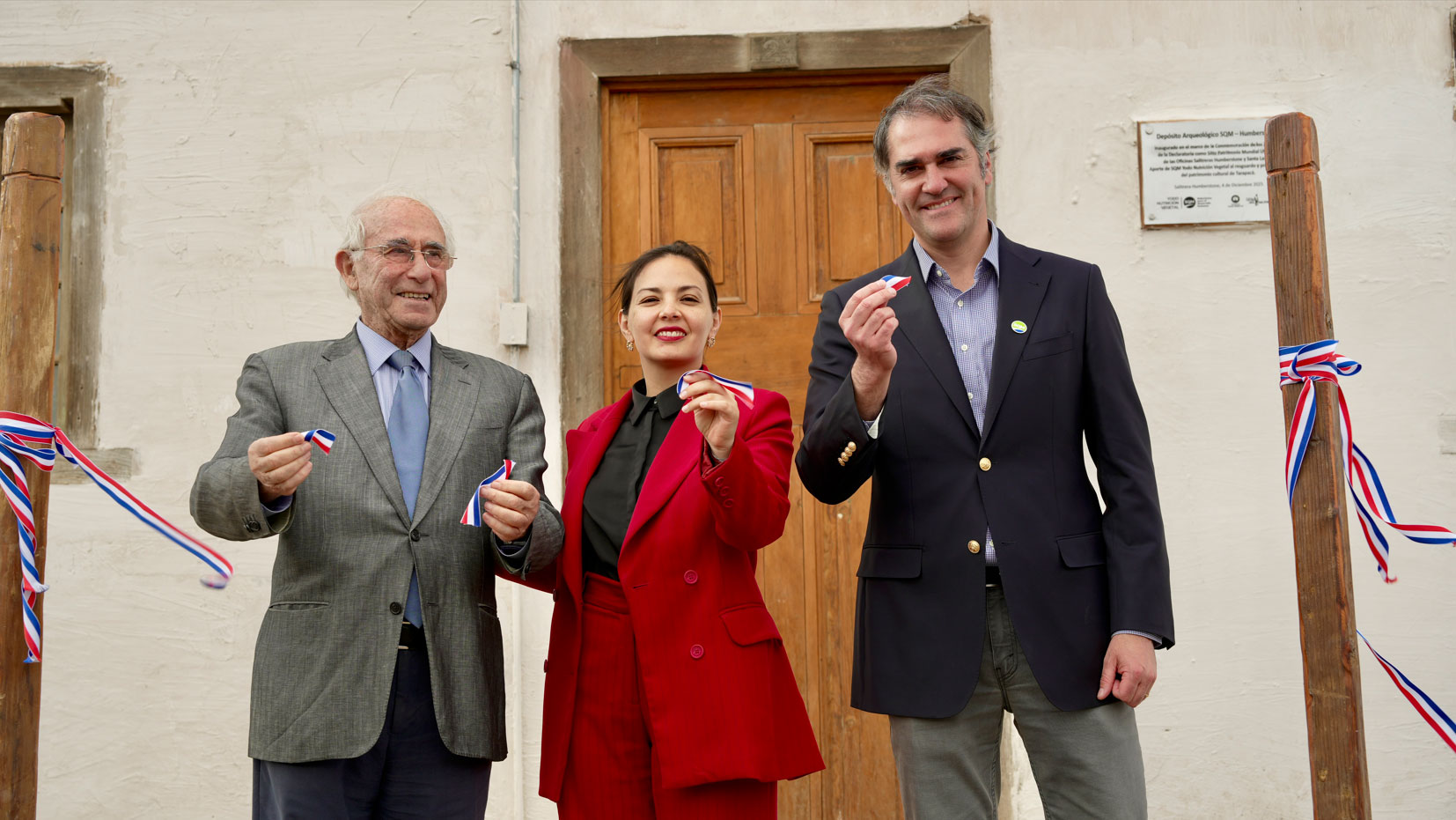
At the Santiago Humberstone Saltpeter Office, and as part of the commemoration of the 20th anniversary of its designation as a UNESCO World Heritage Site, SQM Yodo Nutrición Vegetal took part in the inauguration of the new Archaeological Repository—an infrastructure designed to preserve, under optimal technical conditions, the findings that tell the story of the saltpeter era and the cultural development of northern Chile.
During the event, it was highlighted that this initiative is the result of joint efforts between the Museo del Salitre Corporation and SQM Yodo Nutrición Vegetal, who have collaborated on various conservation projects in recent years. The implementation of this repository marks a key step in safeguarding local heritage, offering an environment specially designed to ensure the proper conservation, classification, and storage of archaeological materials.
Pablo Altimiras, General Manager of SQM Yodo Nutrición Vegetal, stated: “We understand that we do not only operate in this territory—we belong to it. Its history, roots, and legacy are part of our own journey. That is why we firmly believe that modern mining must be an ally of cultural heritage, a committed actor in caring for, preserving, and projecting the memory that shapes our communities.”
The inauguration of the new Archaeological Repository is a concrete demonstration of that commitment. The facility, equipped with high technical standards, will allow for the protection of materials, artifacts, and archaeological evidence that narrate the history of the desert and the golden age of saltpeter. This is not merely an infrastructure project—it is a space dedicated to the long-term preservation of invaluable heritage that deserves professional, rigorous, and sustainable treatment.
Sandra Araya, Environmental Manager at SQM Yodo Nutrición Vegetal, emphasized: “As a technical team, we want to highlight the importance of the specialized work carried out before each piece reaches the repository. It is a collaborative effort with archaeologists and specialists in the laboratories, allowing us to process, analyze, and then properly store each finding, ensuring its long-term preservation.”
During the ceremony, the crucial role played by SQM Yodo Nutrición Vegetal’s Environmental team was also recognized, as their technical expertise made this infrastructure possible. This project represents a renewed commitment to conservation, archaeological research, and the promotion of saltpeter heritage—an effort that helps keep the history of this place alive, accessible, and protected.
In addition, the long-standing value of public–private collaboration was acknowledged. “None of this would be possible without the joint work that has allowed significant progress in the protection of Humberstone and Santa Laura. We express our deep appreciation to the Museo del Salitre Corporation, the Regional Government of Tarapacá, the Ministry of Cultures, and the Ministry of Mining, as well as all institutions that have supported this path. When we unite under a common vision, the results transcend generations,” concluded Pablo Altimiras.